My research concentrates on military history, with a particular focus on the Irish military experience. I am also interested in applied history and pedagogy, and how best to bring history into other disciplines such as economics.
Andrew Dorman, The Army, Society and Soldiering in Ireland, 1699-1793: A New Military History (Martleshom, 2026).
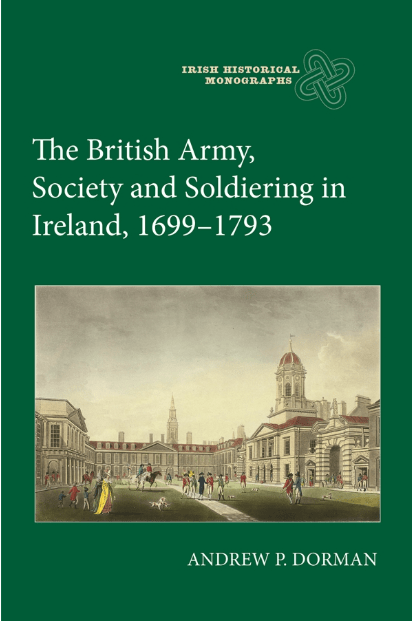
The eighteenth-century army in Ireland, which consisted of 12,000 to 15,000 men, and which was its own quasi-independent “Establishment”, paid for, housed by, and commanded from Dublin, represented a significant proportion of overall British military forces. This book, based on extensive original research, presents an overview of army life in Ireland in the period. It covers the administration of the Irish Establishment, recruitment, desertion, criminality, drunkenness, everyday routines, soldier-civilian relations, the response of soldiers to growing revolutionary unrest, and more. It overturns much established thinking, demonstrating for example that desertion in the army in Ireland was no different from desertion in the army elsewhere, that the army in Ireland was well-trained and efficient, and that Irish soldiers were far more common in British service than previously thought. In addition, the book discusses ideas of masculinity, the army’s place in the defence of Ireland against foreign invasion, in securing the ascendancy regime and in suppressing unrest, and the unusual situation of Ireland as both subject and participant in the development of the British empire.
Available to purchase here.
Chris Colvin, Andrew Dorman, David Jordan, Duncan Needham ‘Applied economic history as practical historicism: Encouraging policymakers to reason with the past’ QUCEH Working Paper Series, 20-02, (2026).
This paper examines how applied history can contribute to policymaking when
understood as a way of structuring judgement under uncertainty rather than as a
source of policy lessons or predictions. It argues that economic history is particularly well suited to facilitating this role because it combines institutional analysis with disciplined comparison of plausible alternatives and close attention to temporal constraints. Distinguishing between micro-pedagogical and macro-institutional applications, the paper analyses two sites of practice: (1) a historically grounded policy simulation used to train early-career civil service economists delivered by the Centre for Economics, Policy and History, a research centre based in Belfast and Dublin; and (2) longer-term engagement between historians and policy advisers in Whitehall organised through History & Policy, an applied history forum. The paper concludes by clarifying the possibilities and limits of applied economic history as a contribution to reflective policy practice.
Available here.
Andrew Dorman, ‘The Irish Soldier in the Eighteenth-Century Ireland’ in Tom Bartlett (ed) Militarium, a history of the Irish soldier (Forthcoming, 2026).
This chapter explores the recruitment and desertion of Irish soldiers in the British army during the eighteenth century. It situates the Irish soldier of the 1700s in a considerable corpus of work that begins in the medieval era and ends in the 21st century.
Manuscript forthcoming
Andrew Dorman, ‘”Fit for immediate service”: Reassessing the Irish Military Establishment of the Eighteenth Century through the 1770 Townshend Augmentation’, British Journal for Military History, 7:2 (2021), pp 42-63.
The Irish Military Establishment of the eighteenth century was established in 1699 to protect Ireland from invasion and to secure the Hiberno-Protestant interest from Catholic insurrection. Regiments were rotated to and from Ireland as required, and Ireland played a major part in British strategy as a barracks for its Empire. Despite this crucial role, the Establishment endures considerable historical criticism and is often described as an ill-disciplined rabble. This paper will reassess this negative perception through a case study of the Townshend Augmentation and material held in the returns of regiments in Ireland from 1767-1771.
Available here.
Andrew Dorman, ‘The Battle of Warburg, 1760’, Journal of the Society for Army Historical Research, 98:394 (2020), pp 313-4.
This research note explores the demise of Major Richard Davenport at the battle of Warburg, whose death had until then been lost.
 Andrew Dorman